By Felix Dowsley, Boys Program Director
“¿Hace frío, Rodolfo?”
“¡Sí! Hace frio.”
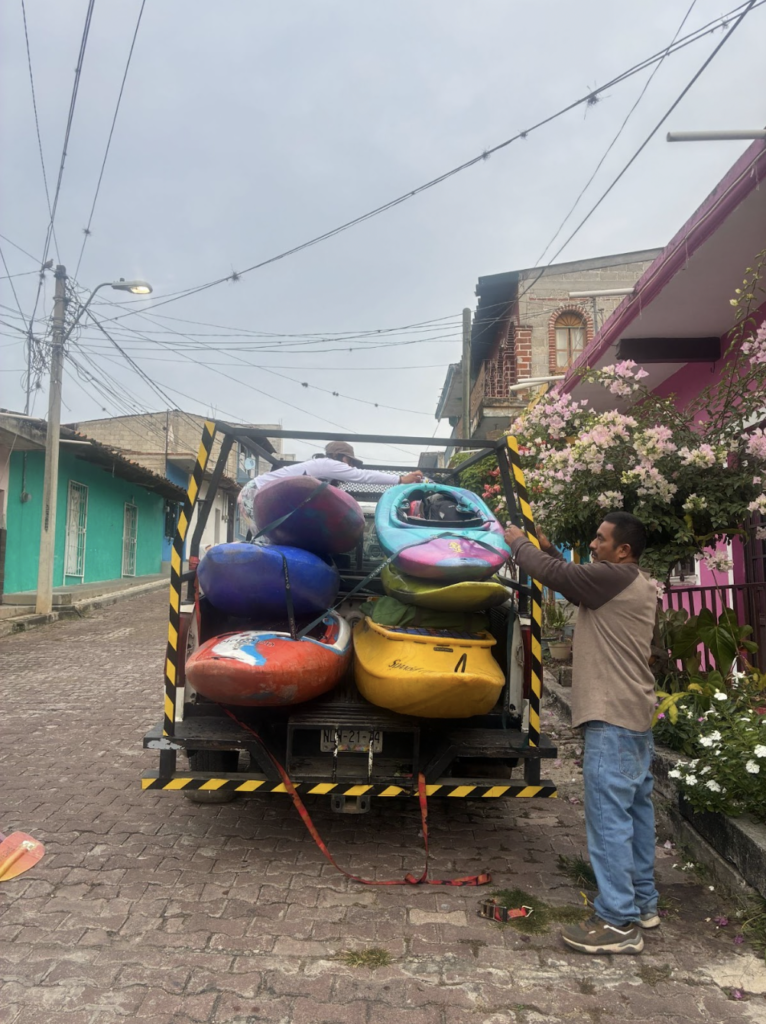
We were cresting the pass between Jalcomulco and Tlapcoyan, headed for the legendarily fun Roadside section of the Alsaseca River. Rodolfo, a former raft guide who switched to driving shuttles after years of abusing his knees carrying boats, huddled over the steering wheel, a comic expression of mock astonishment visible under his hood. It was indeed cold, as we’d gained significant elevation and the region was experiencing unseasonable chilly, rainy weather. Rodolfo was absolutely appalled that it was even colder in North Carolina.
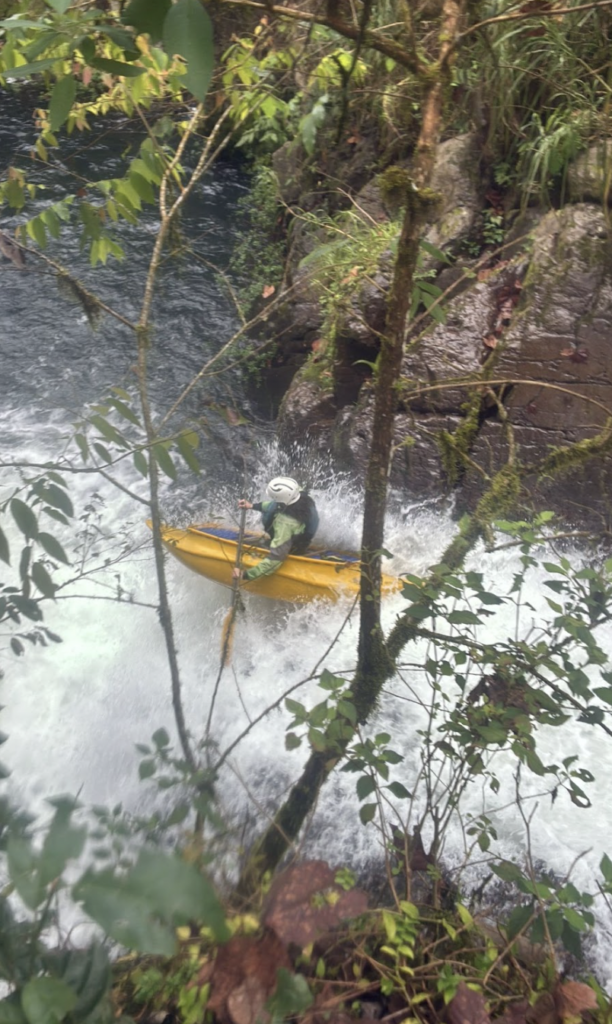
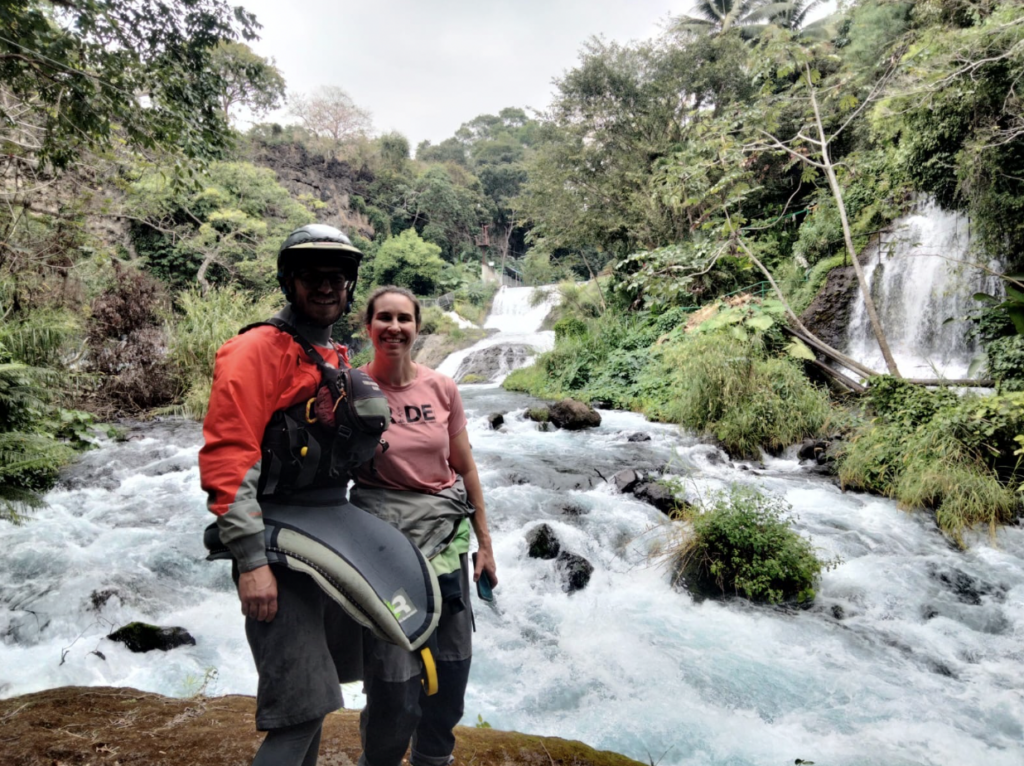
It was our fifth and final day in Mexico, each of which had featured a ride in Rodolfo’s wonderfully capable ‘93 pickup truck. On this mission, we were carting not only our boats but also those of the young shredder kayak crew of Jalcomulco – teenagers who still had braces but could ace a class V waterfall line. In a wonderful example of the smallness of the international kayaking community, our new friend Aisha Jalil had just been paddling with FBRA alum Cashion Porter-Shirley at the Alsaseca Roadside Race. Aisha and Santi showed Anna and me down their local home run, which features nonstop Class IV waterfall drops over clean granite into peaceful pools. At the bottom of each rapid, Anna and I turned to each other with an expression we’ve seen mirrored on each other’s faces on countless adventures: “This is the coolest thing ever!”
Who Is With Us When We Travel
And it was the coolest thing ever, not only because we were doing our favorite thing to do together in a beautiful, new place but because of the interconnectedness of so many people who approach life trying to live fully and help others live fully. I’ve been reading The Mind of the Leader by Rasmus Hougaard and Jacqueline Carter, in which one practice they suggest to develop one’s selflessness as a reader is to meditate on the people who have made one’s successes possible… “those who attended the meetings you attended, […] those who contributed to the projects you are involved in, those who made it possible for you to have something to eat, those who expressed appreciation for you.” The trip that Anna and I took was amazing because of so many people. Easily I think of Rodolfo and Aisha, who shared their hometown rivers with foreigners they’d never met; Jim Coffee, who rented us his house and boats based on trust built through a few days of paddling many years ago; Sam Iatarola, who served as acting Program Director while I was away; our son’s grandparents, who stayed with our little guy while we traveled. But also the “juice ladies,” whose tortas and agua frescas powered our mornings and afternoons; the patient restauranteers and shopkeepers who tolerated our fumbling Spanish with a smile; the people who formed the United Communities of the Antigua Watershed for Free Rivers to block the damming of the Pescados River back in 2015; the farmers who allow paddlers to drive through their land to access the river; the flight controllers who held our plane in Dallas so that the many of us delayed out of Mexico could make it home.
Embodied Connectedness
One of my goals as a paddler is to feel an embodied connectedness to all of the world around me– my boat, the river, the landscape shaping the river, and my companions on the river. It is a felt sensation, one more immediate than reflective thought, and it fills my heart with a peacefulness that I rarely experience outside of nature, even if the next moment I’m getting stuffed in a hole. It is this connectedness that I have found collapses many of the dualities that have dogged philosophers for centuries. Nature and culture and mind and body become blurry and consequently more interesting after the fact. But it also provokes an ethical commitment to the uncountable contingent gifts that make it possible for my wife and I to celebrate ten years of marriage by paddling down rivers some two thousand miles from home. I must ask myself, “am I traveling well? Am I building or breaking connections within Jalcomulco– my connection with it, and the connections that abide in it? Am I teaching children in a way that they too will travel well, will care for their rivershed, will care for the rivershed of a stranger across the world? Am I working to raise my consciousness of how contingent my success is on others? Am I expressing my gratitude to them?”
I’ve been steadily reading Ursula LeGuin’s collected poetry since young Felix was born, as I bought the collection a couple weeks before his due date, and most recently I’ve arrived at So Far So Good, which she edited just before her passing in 2018. It’s been a delight to discover that one of my favorite novelists is a fabulous poet (Harold Bloom would argue above all a fabulous poet, comparable to Yeats). The other night I read her ode “To the rain” and it floored me:
“Mother rain, manifold, measureless,
falling on fallow, on field and forest,
on house-roof, low hovel, high tower,
downwelling waters all-washing, wider
than cities, softer than sisterhood, vaster
than countrysides, calming, recalling:
return to us, teaching our troubled
souls in your ceaseless descent
to fall, to be fellow, to feel to the root,
to sink in, to heal, to sweeten the sea.”
Travel for me is ever and always about leaving and coming home, and the “ceaseless descent” back to rooted-ness while away and while home. What our trip to Jalcomulco reminded me is that it’s also a chance to think about how we might, even with the little drop of ourselves, “sweeten the sea” in which we and all things swim, to become “fellow” with our family, with ourselves, and with strangers.